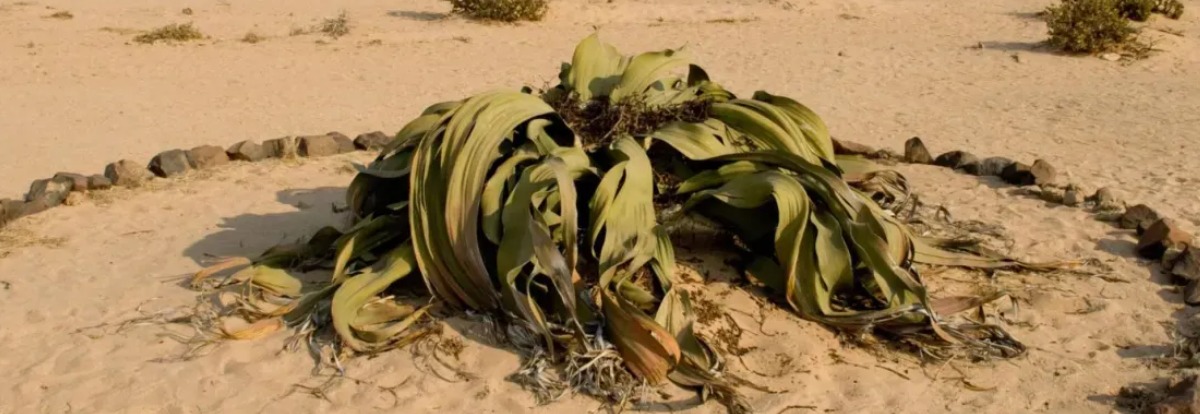
Welwitschia mirabilis – The Immortal Two-Leafed Wonder of the Namib Desert
This bizarre plant looks like a pile of old tires or a stranded octopus half-buried in the sand. Meet Welwitschia mirabilis, one of the strangest and longest-lived plants on Earth.
Quick Facts
- Scientific Name: Welwitschia mirabilis
- Common Name: Welwitschia
- Distribution: Namib Desert (Namibia and southern Angola)
- Lifespan: 500–2,000+ years (some may be older than Christianity)
- Unique Feature: Produces only two leaves that grow continuously for its entire life
Appearance & Identification
The plant consists of a massive woody stem mostly buried in sand, with two long, strap-like leaves that split and shred over centuries into a tangled mess. It produces bright red cones when reproducing. The leaves are tough, leathery, and often sun-bleached at the tips
Habitat, Distribution & Ecology
It survives in one of the driest deserts on Earth by harvesting moisture from coastal fog. It is a “living fossil” — its lineage dates back over 100 million years
Fun Facts
- Named after Austrian botanist Friedrich Welwitsch, who reportedly fell to his knees in amazement when he first saw it.
- The two leaves can reach over 4 meters (13 ft) long but are constantly worn down by wind and sand.
- It is extremely slow-growing and very difficult to cultivate.
Why It Matters
Welwitschia is a symbol of extreme adaptation and resilience. Protecting its fragile desert habitat helps preserve one of the most unique evolutionary experiments still alive today