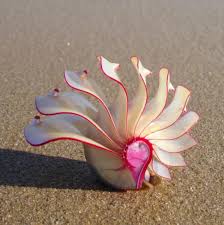
The Rose Nautilus – The Perfectly Spiraled Living Fossil
One of the most elegant natural objects on Earth is the Rose Nautilus shell — a breathtaking chambered spiral with delicate rose, cream, and brown stripes. Often used as a stunning decorative ornament, this is the shell of Nautilus pompilius, a living link to the ancient seas.
Quick Facts
- Scientific Name: Nautilus pompilius (Chambered Nautilus)
- Common Names: Rose Nautilus, Pearly Nautilus, King of Shells
- Type: Cephalopod (related to octopuses and squids, but with an external shell)
- Size: Shells typically 15–25 cm (6–10 inches) in diameter
- Habitat: Deep tropical waters (Indo-Pacific region), often 100–700 meters down
- Status: Not endangered but increasingly rare due to over-collection for the shell trade
Appearance & Identification
The Rose Nautilus shell features a stunning equiangular spiral with natural rose-pink to orange-brown stripes on a pearly white background. When cut or broken, it reveals dozens of intricate internal chambers lined with iridescent nacre (mother-of-pearl). The animal lives only in the newest, largest chamber, using the others for buoyancy control by adjusting gas and liquid levels.
The Living Animal
Unlike most modern cephalopods, the nautilus has changed little in over 500 million years. It has a simple eye without a lens, up to 90 tentacles (no suckers), and a remarkable ability to survive in low-oxygen deep waters. It is a slow-moving scavenger and predator of small crustaceans.
Cultural & Ornamental Significance
For centuries, these shells have been prized as natural ornaments, used in jewelry, cameos, and decorative displays. The “rose” varieties are especially sought after for their warm pink hues. The perfect logarithmic spiral has fascinated mathematicians, artists, and scientists for generations.
Fun Facts
- The shell grows by adding new chambers throughout the animal’s life (they can live 15–20+ years).
- Nautiluses are sometimes called “living fossils” because their basic body plan has remained almost unchanged since the Cambrian period.
- They can retract completely into their shell and seal it with a fleshy hood for protection.
- The internal chambers follow the golden ratio (phi) very closely — one of nature’s most perfect mathematical expressions.
Why It Matters
The Rose Nautilus reminds us of the deep time and mathematical beauty hidden in the ocean. While the shells make beautiful ornaments, sustainable collection and protection of living populations are important to ensure this ancient species continues to thrive in the wild.
Discussion (1)
Sign in to join the discussion